


Regular priceRs. 463,525.20
IGI Certified Lab-Grown Diamond
100% Secure Checkout (UPI, Cards, Netbanking)
Insured Worldwide Shipping
Direct-from-Manufacturer Pricing

Share your questions about certification, sizing, custom settings, or pairings. Our team will get back to you with personalised guidance for this exact diamond.
You can ask us about:
- Ideal ring or jewellery setting for this diamond
- Upgrade options, matching side stones, or bands
- Delivery timelines and worldwide shipping
- Any other detail before you place your order
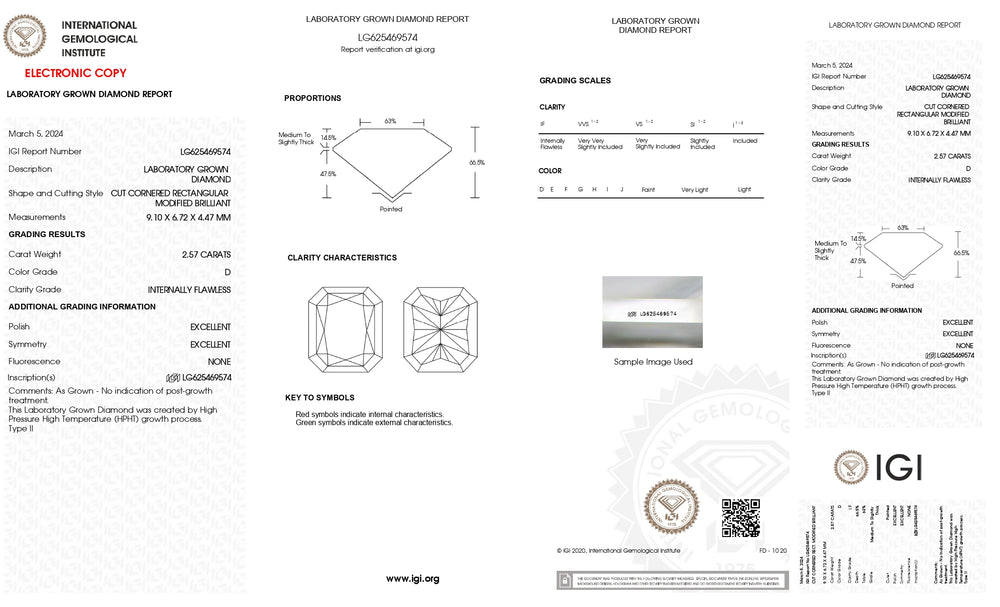
- Type: HPHT Lab-Grown Diamond
- Lab: IGI Certified
- Shape: Radiant Cut
- Carat Weight: 2.57 ct.
- Color Grade: D
- Clarity: Internally Flawless (IF)
- Polish: Excellent (EX)
- Symmetry: Excellent (EX)
- Measurements: 6.72 x 9.10 x 4.47 mm
- Average Diameter to Ratio: 1.35
- Depth: 66.50%
- Table Percentage: 63.00%
- Shade: None
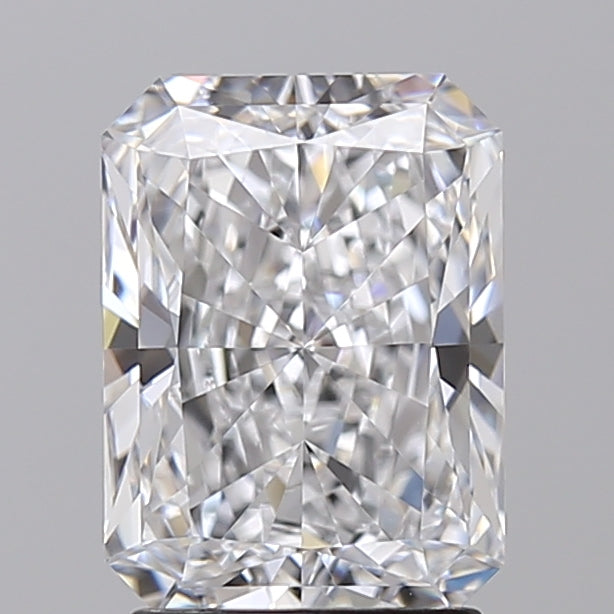
Experience the brilliance of our IGI Certified 2.57 ct. Radiant Cut HPHT lab-grown diamond, featuring a rare D color and flawless clarity. Crafted with excellent polish and symmetry, this diamond showcases ideal proportions with a depth of 66.50% and a table percentage of 63.00%. Perfect for creating luxurious, sustainable jewelry pieces that exude both elegance and ethical responsibility.
Frequently Asked Questions
What makes radiant cut lab grown diamonds different from other shapes? +
Radiant cut diamonds combine the straight edges of an emerald cut with the brilliant
faceting of a round. The result is a bold rectangular or square shape with intense sparkle,
clipped corners, and a very modern, high-impact look.
Do radiant cut diamonds sparkle as much as round diamonds? +
Radiant cuts are one of the most brilliant fancy shapes. While rounds are still the
benchmark for maximum light return, radiant cuts offer exceptional sparkle and fire,
especially when well-cut, making them a great choice for those who want brilliance
in a rectangular or square outline.
Do radiant cut lab grown diamonds hide inclusions well? +
Yes. Radiant cuts use brilliant-style facets that help diffuse light and mask minor
inclusions, especially toward the corners and edges. Many buyers are comfortable
with **VS–SI** clarity in radiant cuts, particularly in lab grown diamonds where
grading is very consistent.
What is a good length-to-width ratio for radiant cut diamonds? +
For rectangular radiants, many people prefer ratios between **1.20 and 1.35**.
Ratios closer to **1.00–1.05** create a more square radiant. The choice depends
on whether you like a more elongated or more compact look.
Do radiant cut diamonds look larger than other shapes of the same carat weight? +
Radiant cuts often appear slightly smaller than elongated shapes like oval or marquise,
but their strong sparkle and corner-to-corner spread give them a powerful presence.
They balance face-up size with maximum brilliance very well.
Are the clipped corners of radiant cuts more durable than sharp corners on other shapes? +
Yes. The trimmed corners make radiant cut diamonds less prone to chipping compared to
shapes with sharp points, like princess or marquise. This makes them a practical
choice for engagement rings and everyday wear.
Which settings look best with radiant cut lab grown diamonds? +
Radiant cuts look stunning in solitaire, halo, double-halo, 3-stone, and side-stone
settings. They pair beautifully with tapered baguettes, trapezoids, or round side stones
for a luxurious and balanced design.
Do radiant cut diamonds show color more or less than other shapes? +
Radiant cuts can show a bit more color than round diamonds but less than some step cuts.
Most people choose **D–H color** for a bright, white appearance. Lab grown options make
higher color grades more affordable and accessible.
Are radiant cut lab grown diamonds certified by IGI or GIA? +
Yes. Radiant cut lab grown diamonds can be certified by IGI, GIA, and other leading
gemological laboratories. Each certificate details the 4Cs, proportions, and growth method
for full transparency.
Do radiant cut lab grown diamonds come in different sizes and styles? +
Yes. Radiant cuts are available in a wide range of carat weights, from under 0.50 ct
to 10+ ct, in both squarer and more elongated proportions. They’re popular for engagement
rings, pendants, and statement earrings.